
The world’s largest development actor, the Catholic Church, and leading voices from the private sector agree that lasting prosperity demands structural reform. Now governments must step up
It was the last panel discussion on the final day of the European Investment Bank (EIB) Group Forum 2026, and Prishani Satyapal, founding CEO of Sustainability Truthing, and executive director of Earth our Common Home (ECHo) wanted to get one thing straight. “We don’t see this as charity. These are investable, bankable projects at scale that need to reach people.” Having left a cushy job in mining to support ECHo, the impact investment fund of the Catholic Church, the South African-born Hindu says: “We only focus on double digit returns”.
ECHo, which is working in partnership with other faith groups to mobilise investment across Africa in sustainable infrastructure – from renewable energy to regenerative agriculture, and healthcare facilities – can deliver scale. As one example, , a confederation of over 160 Catholic relief and development agencies, has 18,000 sites that reach 89 million people. People that need everything from soap to shoes and services, mobile phones and fuel. By 2050, UN projections put Africa’s population at around 2.5 billion, making it the world’s youngest and fastest-growing population, and a major driver of future global demand.
We don’t see this as charity. These are investable, bankable projects at scale
Make development investable
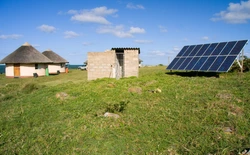
While ECHo understands the importance of commercial returns, it’s primary mission is “to respond to the earth and the cry of the poor”. The two don’t have to be mutually exclusive. Citing the cost of diesel as one example, the reality today, says Satyapal, is that poor communities are “spending more money than any of us, relatively”. Replacing this dirty fuel with solar would reduce their cost of survival, while also delivering double-digit returns.
As the EIB panel outlined, mobilising sustainable private sector investment at scale is the goal of the European Union’s Global Gateway strategy, which launched in 2021. It has committed to mobilising €150 billion towards Africa by 2027 and with a major focus on climate and clean energy, but also on transport, healthcare, digital, and education. Through a Team Europe approach, the goal is to engage EU member states, multilateral institutions, and the private sector in delivering partnerships and shared prosperity for both continents. EIB Global, the development arm of the European Investment Bank, invested €3.1 billion in Africa in 2025 to supports projects in sustainable energy, infrastructure, and small business development.
While the goals are commendable there is, however, evident frustration. For Satyapal, “part of the frustration is that we’ve been hearing conversations about mitigation, adaptation, and resilience strategies, and are consistently told that implementation and scaling is impossible.”
However, another panellist Jorge Moreira da Silva, the UN Under-Secretary-General and Executive Director of the United Nations Office for Project Services (UNOPS), a Global Gateway implementation partner, pointed to evidence of how a demand-driven, country-led projects can work. In Sierra Leone, SOGREA, the Salone Off-Grid Renewable Energy Acceleration, an investment in solar-powered mini-and micro-grids has seen electricity access rise from 6% to 36%.
While that shows scale progress, panellist, Hubert Danso, CEO of Africa Investor, wanted to see much bigger investment and institutional investors in the room. Infrastructure development is an immediate challenge and one hindered by “a persistent and widening funding gap” – $60 billion in 2025 alone, according to Boston Consulting Group. However, Africa’s long-term industrialisation will require trillions of dollars in investment in everything from transport corridors and logistics to energy storage, data centres, AI capability, fibre, housing, and more.
Danso, who runs a platform that connects institutional investors with infrastructure, private equity, and technology projects across Africa, believes that won’t happen without insurers, pension and sovereign wealth funds around the table. It will also require structural reform and a shift from rhetoric to real mobilisation. For this to happen, Danso says: “We must stop trying to make investment developmental, and we must make development investable.”
Silence the echo chambers, let investors come
“Africa is not a development case but a mean reversion story”, says Danso. In other words, while markets and growth often swing between extremes of pessimism and optimism, long-term structural forces prevail and pull performance back toward historical averages.
Long-run datasets maintained by the Maddison Project Database show how in past centuries, Africa contributed as much as 11% to global domestic product. Less conservative estimates put that even higher, at around 14 to 15%. Today, depending on the measure, that number sits at around 3-5%.
Contributing factors to the decline of Africa’s GDP were the rise of mechanised production in 18th and19th century Europe, colonisation organised around raw-material extraction rather than industrial development, and population growth that outpaced productivity.
Africa is not a development case but a mean reversion story
Current trends are changing the direction. Africa’s fast-growing population means no shortage of labour. Urbanisation and digitalisation are driving productivity gains. While intra-African trade remains at just 15%, the Africa Continental Free Trade Area is spurring regional integration and forecasts for growth. Meanwhile, partners from around the world, including China, the Middle East, the EU and Russia, are moving to close Africa’s infrastructure financing gap. Against this backdrop, the trajectory is upwards. Projections are that Africa could reach 7–10% of global GDP by 2050 if trends persist.
Right now, however, significant opportunities are being missed. Africa is home to over 20%- 30% of all critical minerals globally, yet it accounts for the just 1% of the $10-trillion green industrial economy. “We sort of see ourselves in the continent as the largest global donor, because we export a lot of our value,” he says.
Africa is home to over 20%-30% of all critical minerals globally, yet it accounts for the just 1% of the $10-trillion green industrial economy
While G20 principles maintain that every dollar from development banks, development finance institutions, or aid programmes should mobilise $10 of private investment, Danso says: “Africa must settle for 20–38 cents”. He also bemoans the “echo chambers” that Africa is too risky, and private investors are too obsessed with profits.
Profits matter but ESG, the environment, social and governance framework used to measure a company’s sustainability, is no longer a voluntary nice-to-have. There are legal obligations on companies, and growing pressures from governments, investors, consumers and supply chains.
Danso believes that not only do portfolios need to be green, they need to decarbonise the real economy. “You don’t focus on investing in the environment while people starve and people have no livelihoods,” he says. He is also clear, however, that climate and sustainable development in Africa “has to be aligned with ambitious industrial growth”.
Trust and data
Amid continued geopolitical turbulence and global trade wars, there has been a breakdown in trust in the current multilateral system. World Trade Organization Director General Ngozi Okonjo-Iweala, the Nigerian-American economist and global development leader, has acknowledged that “the status quo is not an option”.
Danso argues that the democratisation of data would be one significant step towards correcting mis-priced risk and rebalancing the system for Africa. Yet today GEMs, the EIB’s Global Emerging Markets database, which holds long-run performance data on emerging markets, is not shared widely with investors or rating agencies. That, Danso maintains, has cost emerging market governments $15.6 billion a year in excess interest and “wiped trillions off institutional portfolios over decades”.
The status quo is not an option
Sharing the data would be a “costless exercise” with “priceless impact”, and any confidentiality issues could quickly be sorted out by lawyers, he says, and not doing so, is leading to “a grave and growing lack of trust”.
Rooted in the trust of faith groups, ECHo has a portfolio approach, initial projects, is building an ecosystem, and delivering double digital terms. Meanwhile, the investment community are the largest institutional asset owners. “We can sit down with the government tomorrow,” Danso says, and negotiate institutional investor public partnerships in green hydrogen or renewables with structured investment and expertise in handling project development risk.
As organisations, ECHo and Africa Investor may serve different worlds but they both want the same thing: investment in Africa at scale. “What’s stopping you?” was the question Satyapul put to investors in the room at the EIB Group Forum. Perhaps that is a question even more relevant for governments and their multilateral institutions, not least in Europe, Africa’s closest geographic neighbour.
Call to Action
- Define investable asset classes. Shift from fragmented ESG initiatives to scalable asset classes that create industries, fund managers, and repeatable pipelines.
- Learn from global leaders. Funds such as Norway’s Government Pension Fund Global and Canada’s CPP Investments have embedded sustainability into core portfolio strategy, not as niche.
- Design together, not in silos. Development finance institutions, governments and asset owners must co-create instruments aligned with investor requirements and local market realities.
- Close the data gap. Share datasets (e.g. GEMs) and performance evidence to correct mispriced risk perceptions and unlock institutional capital.
- Scale de-risking and mobilisation tools. Expand the use of blended finance, guarantees, credit enhancements and co-investment platforms to crowd in private investment at scale.
- Ensure inclusion is built in, not added on. Investable systems must reach underserved and marginalised communities, ensuring benefits are widely distributed and reinforcing long-term stability and legitimacy.