
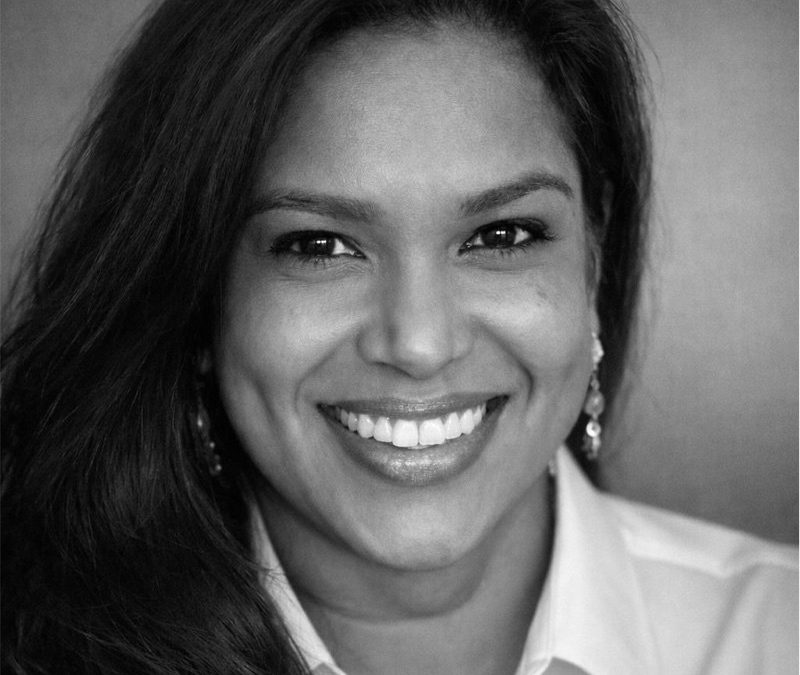
Prishani Satyapal, Executive Director of ECHo, shares her views on markets, finance and development—and explains why Africa is too often framed as an impact story rather than an investment opportunity.
In 2010, Prishani Satyapal attended a meeting at the Vatican alongside the CEOs of some of the world's largest mining companies. At the time, she was working for AngloGold Ashanti, having been recruited to implement the recommendations of her master's thesis across the company's 23 global operations. Her research focused on South Africa's business response to climate change.
Surrounded by the Vatican's sculptures and frescoes, Satyapal witnessed something unusual: corporate egos giving way to a deeper discussion about responsibility, legacy and the industry's licence to operate. The conversation centred on a question that has long challenged extractive industries: what happens when mining leaves?
It was there that she met Ghanaian Cardinal Peter Kodwo Appiah Turkson, who posed a provocative idea: why not apply the same asset-based development model used by mining companies to the Catholic Church's vast land holdings and community presence around the world?
Having worked across AngloGold Ashanti's operations with finance teams, engineers and strategy leaders, Satyapal was never a conventional sustainability practitioner. Her focus was on solving core business problems and unlocking value through practical, scalable solutions.
Today, she is applying that same mindset to mobilising investment in underserved communities across Africa as Executive Director of ECHo, the Catholic Church's impact funding vehicle in Africa. ECHo, or Earth our Common Home, launched in 2023
In your work at AngloGold Ashanti, you say you were looking for ‘unusual partnerships'. What do you mean by that?
The most effective partnerships I’ve seen are the ones you wouldn’t normally pursue. At AngloGold Ashanti, we worked with the United Nations Development Programme, which at the time was unusual for a mining company, and also with the Catholic Church.
We were deliberately looking for ‘critical friends’—partners who had deep, long-term experience in building trust with communities. That’s something extractive industries often struggle with.
What did the mining sector learn from working with the Church?
It fundamentally changed how we thought about “social licence to operate.”
The Church operates on a very different basis. At its core is human dignity and meaning. That framing helped us understand that social licence isn’t something you manage; it’s something communities grant based on trust and long-term presence.
Engaging with leaders like Cardinal Peter Turkson also shifted the tone of leadership discussions. It’s very hard to enter those conversations with ego. That created space for a more honest rethinking of the role of business.
What did this shift lead to in practice?
It led to large-scale changes in how mining companies operated. We started investing in economic development beyond mining, addressing the question of what happens when mining leaves. We also focused on environmental remediation and enhanced operational practices. But more broadly, it was about reimagining how mining assets interact with the communities around them.
The core idea was to take that 'asset reimagining' approach and apply it beyond mining. The Catholic Church has a vast network of assets embedded in communities such as schools, clinics and land. The question was: how do you turn those into investable platforms, that enhance meaningful existence for all communities?
We worked with Church leaders over several years to build what is now the ECHo Fund starting with a theory of change that identified 61 challenges and translated them into seven investable solutions.
What does that look like in practice?
We’re starting with energy as the enabling layer, but also focusing on healthcare, education and agriculture. In Nigeria alone, we have 18,000 sites, with the potential to reach around 89 million people. That translates into roughly a $3 billion investment opportunity.
What’s important is that these assets come with a different risk profile. Institutions like the Catholic Church and other faith groups are not exposed to political cycles in the same way as governments, which creates stability. A political leader might change but the Imam or Bishop doesn’t.
We feel that the quality partnership with the Catholic Church and other faith groups allows for a buffering of that risk. It reaches communities that investors otherwise wouldn't reach.
You’ve argued that investors are getting Africa wrong. How?
The biggest issue is that Africa is still being framed as an 'impact story'. It isn’t. It’s a consumer market. It’s a supply-constrained environment where demand already exists. People are working, trading, buying but they lack access to affordable, scalable solutions.
The Chinese often get a bad rap for this because they are willing to see our markets as markets. Western/European investors are missing that. They’re not seeing African communities as consumers, our markets as markets, and that leads to a fundamental mispricing of opportunity.
Africa is still being framed as an 'impact story'. It isn’t. People are working, trading, buying but they lack access to affordable, scalable solutions.
What has changed in the last two to three years to make this more investable?
The commitments, particularly from Europe, haven’t changed much. What has changed is the visibility of the gap between ambition and execution.
There’s also been a shift in how investors think. Impact is no longer a niche, it’s embedded. But at the same time, there’s a much stronger focus on resilience and long-term stability.
We’re also seeing better institutional collaboration—for example between the World Bank, European Investment Bank and African Development Bank. That’s a real step forward.
If the opportunity is clear, why isn’t capital flowing at scale?
Because risk is still being misunderstood. We keep having the same conversations around currency risk, political risk, exit risk. But there are already tools to manage these, including guarantees from institutions like the Multilateral Investment Guarantee Agency.
The issue isn’t the absence of solutions. It’s that those tools aren’t being used effectively or brought into the room early enough.
Where do you see the most “missed” opportunity and what is the solution?
Many institutions speak enthusiastically about clean energy investment yet fail to connect those discussions with their own carbon and carbon trading capabilities. Carbon monetisation, including mechanisms such as upfront carbon purchase agreements, could serve as an important source of predictable cash flow and therefore as a meaningful risk mitigation tool within project design. However, these conversations are often hampered by institutional fragmentation: the people responsible for carbon sit in different parts of the European system and are not brought into the same room as energy investors and guarantee specialists. This separation is emblematic of the broader problem: institutions possess many of the tools they need, but those tools are divided across organisational silos.
Mission 300 has created a better and more collaborative institutional framework, but the real test now is whether those institutions can move beyond siloed, repetitive risk discussions and begin designing solutions together with the full range of actors round the table – not just the energy investment team but the credit guarantee team, the risk specialists, and the carbon market experts.
All those capabilities already exist within institutions. They just aren’t being brought together. If you bring them into a single conversation, you can design solutions that address risk upfront rather than debating it repeatedly.
Mission 300 aims to connect 300 million people to energy access by 2023
What does a more effective investment approach look like?
Start small and execute.
Rather than announcing large, abstract commitments, begin with 10 projects. Build a track record. That’s the best way to start with managing risk, to have some level of execution and build policy from that process. Then scale.
That kind of stage-gate approach allows investors to understand risk in practice, rather than trying to model it perfectly upfront.
What are the biggest barriers you’re encountering?
Access and process.
One of the problems is that policies, which have been so extraordinarily overwritten, are not fit for world that we know is changing as much as it is. The agricultural market impacts of Ukraine war was an opportunity for Europe and Africa to have better partnerships but when the Straits of Hormuz closed the same thing has happened with fertilizer prices. There's a market that doesn't go away, yet we haven't taken that opportunity.
Another issue is that takes significant time and resources just to get in front of European investors. The requirements, such as setting up fund structures, are expensive and complex, often before any capital is deployed.
There’s a mismatch between the ambition to invest in ‘new markets’ and the cost of entering those markets.
Policies, which have been so extraordinarily overwritten, are not fit for world that we know is changing as much as it is
How important is local production and value chains in this?
It’s critical. If Europe tries to manufacture at home and export into Africa, it will struggle to compete. The cost base is simply too high.
The opportunity is in building local value chains. In other words, taking a portofolio-based approach and investing across the full ecosystem rather than treating Africa as an end market.
ECHo is a relatively new fund. How are you drumming up investment, and what are the challenges?
The market is not a place where you can just launch a fund and expect people to love you. So we’re looking for partnerships and engaging as originators who have a portfolio that is very well modelled in terms of energy but also allows for secondary investments in other sectors. We will work with existing funds until we have enough large-scale implementation (over $125 million) and then will examine our fund structure differently.
ECHo has partnered with EPC (engineering, procurement and construction) companies which provide specialised turnkey services for large-scale infrastructure projects, handling everything from initial design to final construction. In the interim, they are funding the initial projects –– around 50 megawatts per company. These EPC companies are registered with the World Bank and the International Finance corporate giving them access to working capital facilities and potential grant subsidies. So, there's a quality of due diligence and delivery on the ground.
One hurdle is the time and resources it takes to get in front of a European investor. Not only do you need to sit in front of the EBRD (the European Bank for Reconstruction and Development), you also have to register the fund in Luxembourg which requires a €2 million investment.
What will investors still be getting wrong in five years?
I hope they get more right than wrong. But historically, Africa has remained a small allocation in most portfolios.
Where I think we will see progress is in resilience. Investors will increasingly recognise that investing in Africa strengthens their own supply chains and market access, particularly in areas like agriculture and technology.
But whether they embrace the opportunity for scale, remains an open question.